
English (Original)
Fifty million years ago, a geological cataclysm of unfathomable magnitude forever altered the topography of our planet. The Indian subcontinent, propelled by the unstoppable engine of tectonic drift, slammed into the Eurasian plate with a violent crescendo. From this monumental collision arose the Himalayas—a formidable fortress of stone and ice that intercepts monsoons, births three of Asia’s most vital rivers, and dictates the meteorological fate of half the globe. Nestled within this jagged, stratospheric landscape was born Nepal, a sovereign nation that inherently defies the very parameters of human habitation. It is a realm where prehistoric megafauna still roam ancient grasslands, where isolated settlements cling precariously to vertical slopes, and where the zenith of the Earth physically brushes against the fringes of the stratosphere.
Out of the ten highest peaks that pierce the global skyline, eight are anchored within Nepal's borders. To comprehend the sheer scale of this environment is to confront human insignificance. The ascent of Mount Everest begins at Base Camp, situated at a staggering 17,600 feet—an altitude that eclipses the summits of most conventional mountains. Here, a transient metropolis of vividly colored tents sprawls across the glacier, akin to a tapestry of prayer flags, sheltering climbers who spend grueling weeks acclimatizing their physiology for the insurmountable trials ahead. The ascent itself is an endeavor through a landscape that feels seemingly borrowed from a hostile, extraterrestrial world. The Khumbu Icefall, a treacherous labyrinth of shifting, house-sized ice blocks, demands climbers to cross bottomless crevasses via flexing aluminum ladders. Higher still, the Lhotse Face rises as an intimidating wall of blue, sheer ice, where a momentary lapse in concentration equates to a fatal, 4,000-foot plunge.
When mountaineers finally breach the 29,032-foot summit, they encounter an atmospheric realm where the curvature of the Earth becomes distinctly visible, and the sky deepens into an abyss of blackish-blue. Every breath taken in this "Death Zone" feels borrowed from eternity. Yet, the mountain exacts a harrowing toll for this fleeting triumph. The infamous "Rainbow Valley" serves as a visceral, sobering reminder of mortal fragility; it is adorned not with natural splendor, but with the vibrantly colored down suits of those who succumbed to the elements and never returned. The statistics are unequivocally grim, yet they do not deter the human spirit.
Equally unforgiving is the Annapurna massif. While thousands of intrepid trekkers embark on the three-week circumambulation known as the Annapurna Circuit, the summit itself is notoriously lethal, claiming the life of one in every three individuals who dare to conquer it. The circuit, stretching across 230 kilometers, is a masterclass in geographical and cultural transience. It initiates in subtropical valleys where emerald rice terraces aggressively ascend impossible gradients, transitions through rhododendron forests blooming like organic temples, and culminates in the lunar desolation of the Thorong La Pass at nearly 18,000 feet. It is not merely a physical ordeal but a profound cultural passage; as altitude increases, the spiritual demographic seamlessly transitions from Hinduism to Buddhism, as if spirituality itself becomes lighter in the thinning atmosphere.
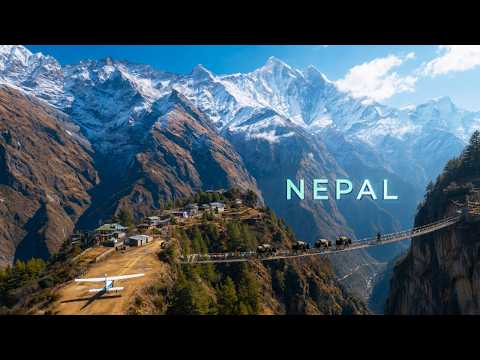
None of this high-altitude exploration would be conceivable without the Sherpa people. Far from being mere porters, they are the indispensable custodians of the precipice. They navigate this hostile terrain with an instinctual mastery, bearing unimaginable physical burdens, fixing ropes on perilous ridges, and making split-second calculations that frequently mean the difference between life and death for foreign expeditions. Accompanying them are the yaks—creatures built like perambulating woolen fortresses. Weighing as much as small vehicles, these resilient beasts navigate glacial ice with broad hooves, pausing to graze on sparse alpine flora while their breath condenses into thick clouds in the frigid air.
Descending from the unforgiving high Himalayas, one encounters a fragile civilization painstakingly constructed in a seismically volatile basin: the Kathmandu Valley. Here, three ancient kingdoms have weathered centuries of devastating earthquakes that periodically rewrite the landscape. Kathmandu’s Durbar Square is an architectural hallucination made manifest. Intricate, multi-tiered palaces and pagoda-style temples seem to defy both gravity and the relentless march of time. Within this labyrinthine complex, one can find ascetics—Sadhus draped in saffron robes, their bodies smeared with sacred ash, representing humanity’s most archaic experiment in absolute renunciation. They have consciously relinquished every trapping of modern existence to sit in profound meditation amidst the sensory overload of the city.
Kathmandu pulses with a dizzying, paradoxical rhythm. It is a city where electrical wires tangle overhead like urban prayer beads, intertwining medieval neighborhoods with flickering Wi-Fi signals. The air is heavily permeated with an olfactory cocktail of burning incense and diesel exhaust, while the cacophony of blaring car horns harmonizes bizarrely with the resonant tolling of temple bells. It feels as though utter chaos has been miraculously blessed by a pantheon of deities and instructed to function. In 2015, a catastrophic 7.8-magnitude earthquake reduced historic landmarks like the Dharahara Tower to mere rubble in a matter of seconds. Yet, reflecting the indomitable resilience of the Nepali spirit, it was resurrected from the debris, standing today even taller than its predecessor.
This juxtaposition of creation and destruction is palpable at the Pashupatinath Temple, situated along the sacred Bagmati River. Here, the eternal cycle of existence is on full display as Hindu cremation fires burn ceaselessly on stone ghats. Fire transmutes mortal flesh into ash, and the sacred waters carry the remnants toward spiritual liberation. Meanwhile, Nepal adheres to its own temporal dimension, strictly following the Bikram Sambat calendar, rendering the nation approximately 57 years ahead of the Gregorian calendar. Time here is remarkably fluid; past and present do not merely follow in sequence but exist in a symbiotic synchronicity.
Further south, where the precipitous slopes finally surrender to the vast, sweltering plains of the Terai, an entirely different manifestation of survival unfolds. Chitwan National Park stands as a triumphant beacon of modern conservation. Decades ago, the greater one-horned rhinoceros was hunted to the brink of total annihilation. Today, through draconian anti-poaching measures and relentless dedication, over six hundred of these prehistoric juggernauts lumber through the dense elephant grass. The park also boasts one of the highest densities of Royal Bengal tigers on the planet, their beautifully striped silhouettes moving with a lethal, fluid grace through the underbrush.
Just a short distance from this untamed wilderness lies Lumbini, a site that catalyzed a philosophical revolution over two and a half millennia ago. It is the hallowed birthplace of Siddhartha Gautama, the Buddha. Lumbini is not merely a singular shrine, but an expansive, sacred topography symbolizing a doctrine that conquered half of the world without ever unsheathing a sword. Monasteries constructed by nations spanning from Sri Lanka to Japan dot the landscape, each reflecting their unique cultural interpretations of Buddhist architecture, yet all radiating the same fundamental message of compassion and inner tranquility.
Between the desolate death zones of the peaks and the fertile humidity of the southern plains lies the middle realm—the quintessential heartland of traditional Nepal. Here, life is a testament to human tenacity over topography. Mules traverse dizzying suspension bridges that sway violently over plunging chasms, forming the commercial backbone for isolated communities. It was in these very hills, specifically in the district of Gorkha, that the nation’s unification was forged. From these rugged ridges emerged the legendary Gurkha soldiers, warriors whose reputation for unparalleled valor and ferocity reverberates across global military history.
Nepal is a paradox of staggering proportions. It is the oldest country in South Asia, proudly boasting a history devoid of foreign colonization, yet it grapples continuously with the fragility of a nascent democracy. It is a geographical anomaly where one can freeze to death in a blizzard in the morning and suffer from heat exhaustion in a subtropical jungle by the afternoon. With over 120 spoken languages and a myriad of ethnic groups coexisting in relative harmony, Nepal is a living testament to the fact that diversity can be a profound source of strength rather than a catalyst for fracture. Through seismic devastation, treacherous geography, and the relentless passage of time, Nepal does not merely survive; it adapts, it rebuilds, and it endures, forever claiming its title as the most impossible—and perhaps the most awe-inspiring—country on Earth.