
English (Original)
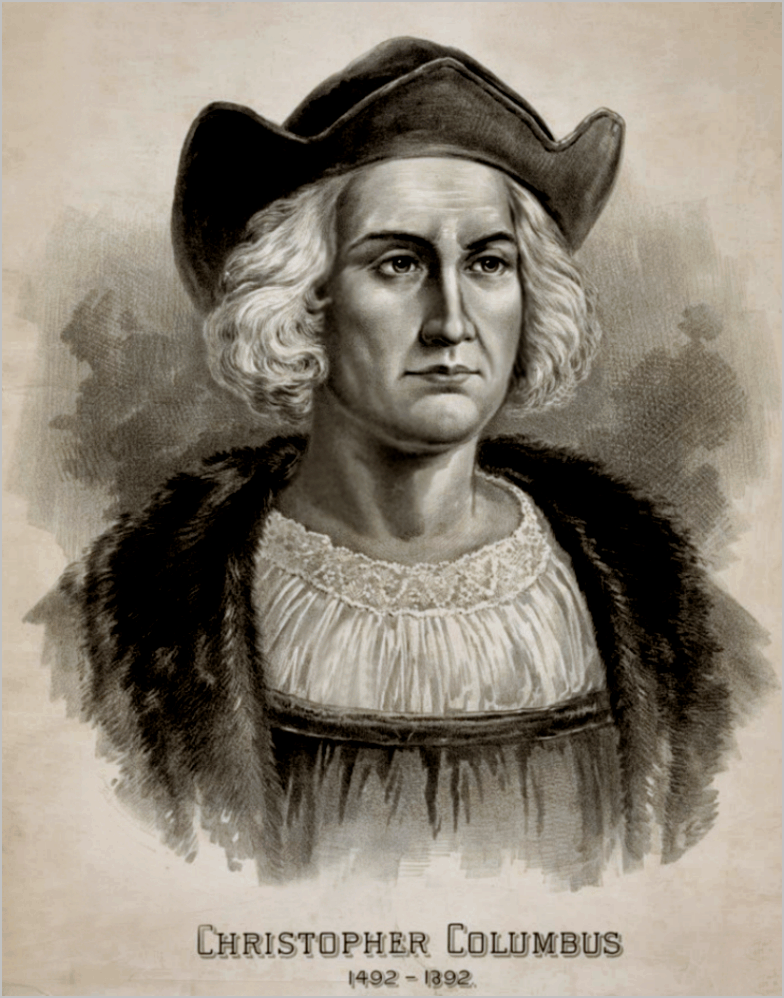
Christopher Columbus is widely remembered as the man who discovered America, but his actual history is far more complicated and controversial. While he was a determined ocean navigator, his harsh actions toward local populations and his hunger for gold damaged his legacy, eventually turning him into a disgraced leader.
Born around 1451 in Genoa, Italy, Columbus was the oldest son of a weaver and innkeeper. Although his family lived modestly and he had little formal schooling, he showed great curiosity. He began sailing at the young age of fourteen. Over time, he taught himself several languages, mathematics, astronomy, and the art of mapmaking. He survived dangerous sea battles and traveled across parts of the Atlantic, including trips to Iceland and African coastal regions.
During these journeys, Columbus formed an ambitious theory. He was convinced that by sailing west across the Atlantic Ocean, he could quickly find a direct trade route to Asia. However, his scientific calculations were flawed. He believed the Earth was much smaller than it truly was, and he did not expect any large continents to block his path. Despite these mistakes, he persuaded the Spanish monarchs, King Ferdinand and Queen Isabella, to fund his daring expedition in exchange for riches and titles.
When Columbus reached the Caribbean islands, he thought he had arrived near Asia. Driven by the need to repay debts and satisfy the Spanish crown, he focused aggressively on mining gold and taking captives. Yet his severe rule as governor on the island of Hispaniola created deep resentment among both the native islanders and European settlers. His administration was so harsh that Spanish royal investigators eventually placed Columbus in chains and sent him back to Spain in disgrace.
Although King Ferdinand freed Columbus and allowed him a fourth voyage in 1502, he forbade him from governing Hispaniola again. This final expedition was filled with severe storms and shipwreck, leaving Columbus and his crew stranded in Jamaica for nearly a year.
By the time he returned to Spain in 1504, Columbus was seriously ill and broken in spirit. Even though he was granted part of his promised wealth, his health deteriorated rapidly, and he died in May 1506 at age fifty-four. Today, historians view him not as a simple hero, but as a skilled sailor whose severe governance brought tragic consequences.